CPM Calculator
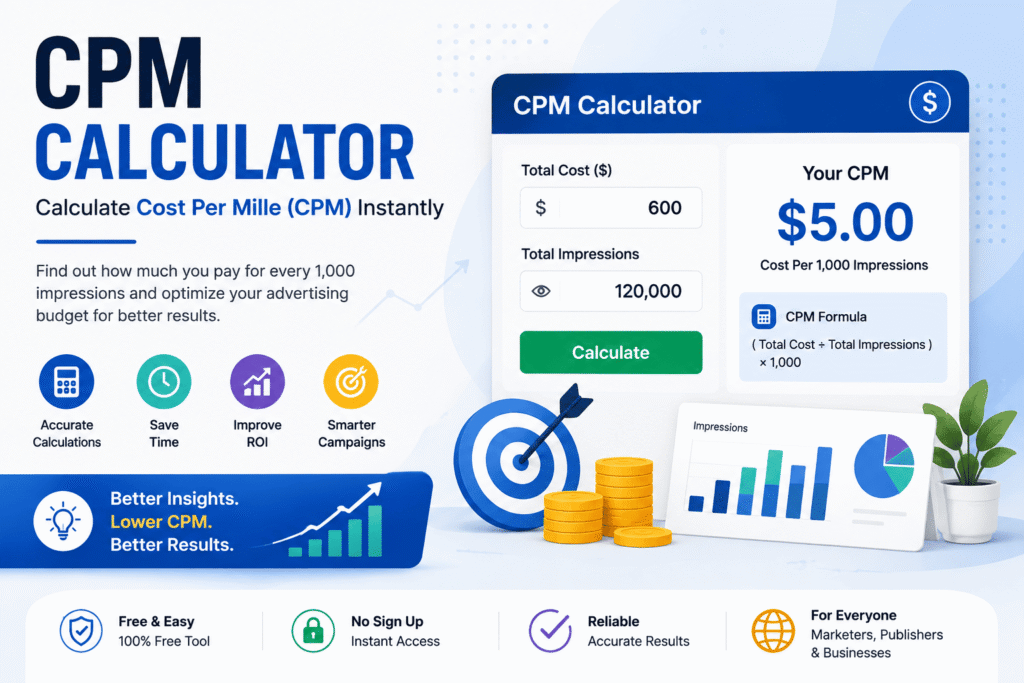
Use our free CPM calculator to find out how much you are paying for every 1000 impression.

CPM Calculator Pro
Fill any 2 fields to calculate the 3rd automatically
CPM: —
Cost: —
Impressions: —
Formula: CPM = (Cost ÷ Impressions) × 1000
Free CPM Calculator
Use our free CPM Calculator to calculate Cost Per Mille (CPM) in seconds. Whether you’re running Google Ads, Facebook Ads, display advertising, or programmatic campaigns, this tool delivers fast and accurate results.
Enter Your Campaign Data
Simply enter your total advertising cost and the number of impressions your campaign received. Our online CPM Calculator automatically processes your data to provide a precise cost per 1,000 impressions.
Calculate Your CPM Instantly
Click the calculate button to instantly see your campaign’s CPM, helping you measure advertising efficiency without manual calculations. The tool uses the standard CPM formula to ensure reliable and accurate results every time.
How to Use This CPM Calculator
Using this Cost Per Mille Calculator is quick and beginner-friendly. Enter your campaign values, calculate your CPM, and use the results to optimize your marketing budget, compare ad performance, and improve your digital advertising strategy.
What Is CPM?
Cost Per Mille (CPM) refers to a digital advertising aspect that entails computing the cost an advertiser incurs for a thousand impressions of their ad. This method is used by marketers, advertisers, and publishers alike when assessing the efficient portions of online display ad campaigns on every type of platform.
CPM Meaning in Digital Advertising
In the terminology of digital marketing, CPM is an acronym for cost per thousand impressions. The word mille comes from the Latin word for thousand which indicates that it refers to the sum which is a payment made for the advertisement when it reaches 1,000 views regardless of whether the viewers click on it.
Why CPM Matters for Advertisers
CPM stands for Cost per Mille and is an essential metric in advertising that helps assess both the brand’s awareness of the campaigns and its budget efficiency. It enables companies to calculate and compare advertising costs of various networks including Google Display Ads, Facebook Ads, YouTube, etc.
When Should You Use CPM?
Use the CPM pricing model when your intention is to strengthen visibility, achieve maximum impressions, and enhance brand awareness, rather than to secure clicks or conversions. This model fits best in cases of display ads, video advertisements, social media advertising, and programmatic advertising, where you can get in touch with a wide audience.
CPM Formula Explained
By grasping the CPM formula, you can determine the cost per 1,000 impressions and analyze your advertising results effectively. It does not matter if you are operating with Google Ads, Facebook Ads, or display ads, this calculation is key to better budget planning.
Standard CPM Formula
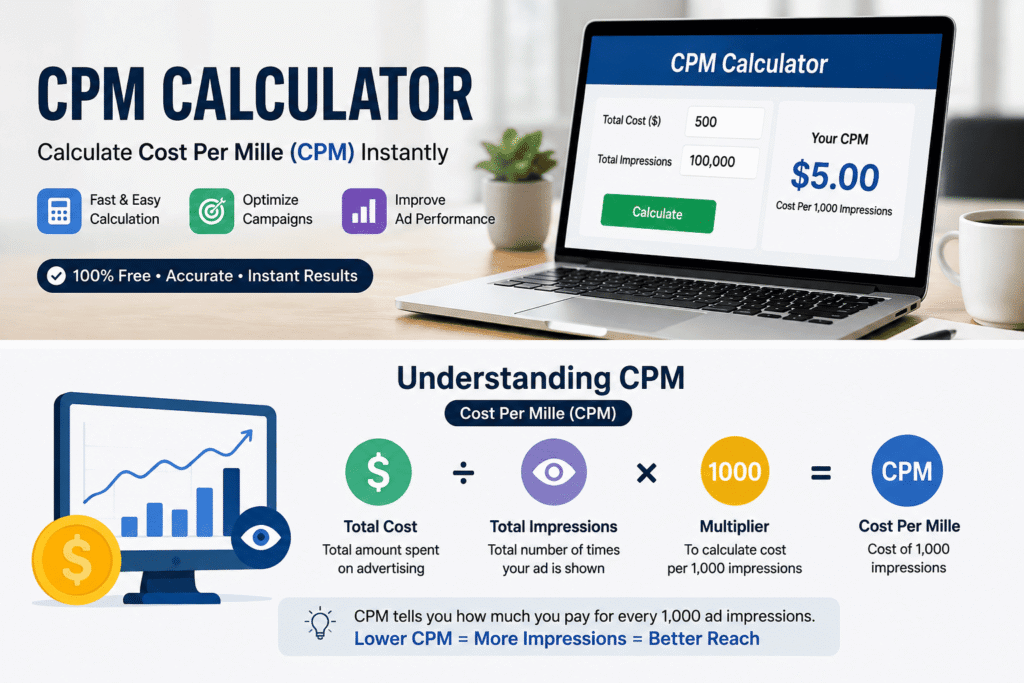
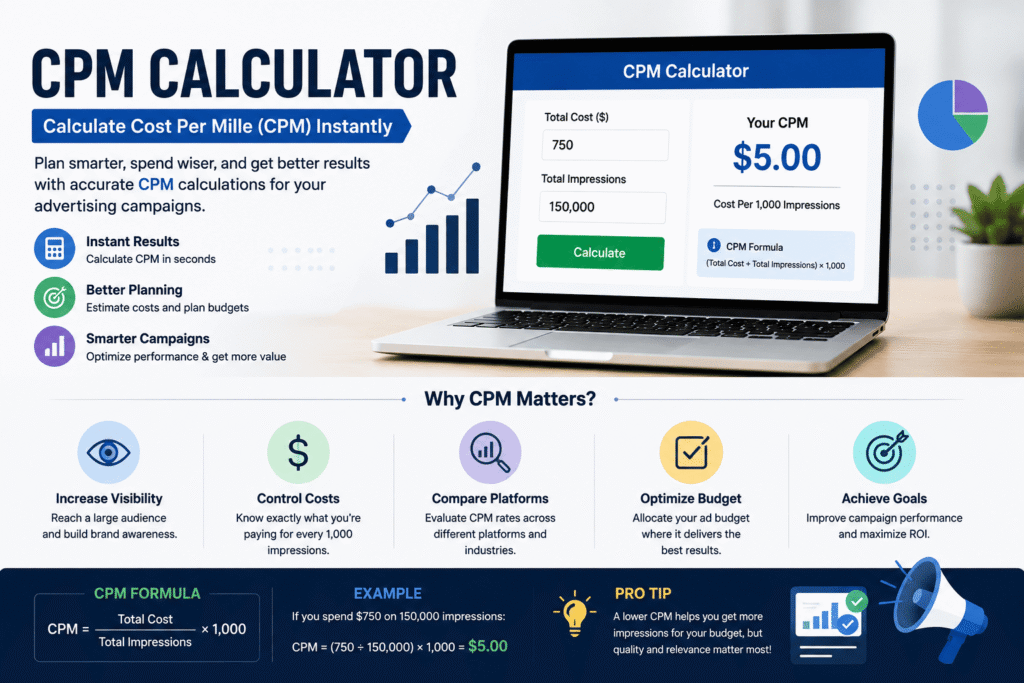
The general CPM equation is: CPM = (Total Advertising Cost ÷ Total Impressions) × 1,000. This equation shows the amount an organization spends for every 1,000 ads, making it one of the most frequently used digital marketing measurements.
Reverse CPM Formula
The reverse CPM formula allows you to calculate your total cost of advertising when CPM and the number of impressions are available. Simply apply this equation: Total Cost = (CPM × Total Impressions) ÷ 1,000 and you will be able to estimate your expenses for your advertising campaign with great certainty.
Formula Breakdown with Variables
In CPM computation, Total Advertising Cost refers to what you have spent on the campaign. Total Impressions, on the other hand, tells you the number of times the ad has been shown. The answer is multiplied by 1,000 to give the answer in the standard CPM measurement of online advertising.
How to Calculate CPM
After you’ve discovered the total ad cost and total impressions, figuring out the CPM (Cost Per Mille) is easy. Use our CPM Calculator to figure out the cost of a thousand ad impressions, or use the formula yourself.
Step-by-Step Calculation
The initial step to calculate CPM is to take the overall cost of your campaign and divide it by the total impressions. After that, take the result and multiply it by one thousand. This simple calculation proves to be a very good method to determine the effectiveness of your campaign and plan your advertising finances.
Real-Life CPM Calculation Example
Suppose you spend $500 on a display advertising campaign that generates 100,000 impressions. Using the formula ($500 ÷ 100,000) × 1,000, your CPM is $5, meaning you paid $5 for every 1,000 impressions.
Common Calculation Mistakes to Avoid
It is important not to confuse impressions and clicks since this mistake can generate erroneous CPM figures and wrong campaign evaluation. Always use the total amount you spend on ads and total impressions making sure you have accurate and current data.
What Is a Good CPM?
An effective CPM relies on the advertising platform you use, your target market, your sector, and your campaign goal. Although your CPM can be lowered, this is not ideal unless it allows for good impressions.
Average CPM by Advertising Platform
Average cost per thousand views (CPM) price differs between various platforms like Google Display Network, Facebook Ads, Instagram Ads, LinkedIn Ads, and YouTube Ads. The benchmarks of different platforms help advertisers in selecting the appropriate medium and maximizing their digital marketing budget for getting better results.
Average CPM by Industry
Every sector has different average CPM benchmarks as per the competitive landscape factors, level of demand from an audience, and seasonal trends. The sectors such as finance, insurance, legal and SaaS usually have a higher CPM while sectors such as entertainment, education, and lifestyle usually have a lower CPM due to lower advertising costs.
Factors That Affect CPM Rates
Your CPM is impacted by a number of factors, such as the targeting of your audience, ad placement, competition, geographical location, type of device used, and ad quality and timing. By increasing the relevancy of the ad, improving the quality of the ad creative, and refining the ad targeting, you can obtain lower CPM with a higher return on advertising spend (ROAS).
CPM vs CPC vs CPA
CPM, CPC, and CPA are three of the most common digital advertising pricing models, each designed for different marketing objectives. Choosing the right model depends on whether your goal is brand awareness, website traffic, or conversions.
Key Differences
CPM (Cost Per Mille) charges for every 1,000 ad impressions, CPC (Cost Per Click) charges only when someone clicks your ad, and CPA (Cost Per Acquisition) charges when a user completes a specific action or conversion. Understanding these advertising models helps you select the most cost-effective strategy for your campaigns.
Which Pricing Model Is Best?
There is no single best advertising pricing model, as each serves a different purpose and campaign goal. CPM is ideal for increasing visibility, CPC focuses on driving qualified traffic, and CPA is best for maximizing conversions and improving return on investment (ROI).
When to Choose CPM Over CPC or CPA
Choose CPM when your priority is to maximize brand exposure, audience reach, and ad impressions across display and social media platforms. It works best for brand awareness campaigns, product launches, and businesses looking to build recognition before focusing on clicks or sales.
Benefits of Using a CPM Calculator
A CPM Calculator helps advertisers, marketers, and publishers calculate Cost Per Mille (CPM) quickly and accurately without manual calculations. It simplifies campaign analysis, improves decision-making, and helps optimize your digital advertising strategy.
Save Time
Our free CPM Calculator delivers instant results, eliminating the need for complex formulas or spreadsheets. With just a few inputs, you can calculate cost per 1,000 impressions and focus more on improving campaign performance.
Improve Budget Planning
Knowing your CPM allows you to estimate advertising costs, allocate your marketing budget more effectively, and avoid unnecessary spending. Better budget planning leads to smarter investments across Google Ads, Facebook Ads, and display advertising campaigns.
Optimize Advertising Campaigns
By tracking your CPM rate, you can compare campaign performance, identify cost-saving opportunities, and improve your return on ad spend (ROAS). Regular CPM analysis helps optimize audience targeting, ad creatives, and overall digital marketing performance for better results.
How to Lower Your CPM
Lowering your CPM (Cost Per Mille) helps you reach more people while keeping your advertising costs under control. By improving campaign quality and targeting the right audience, you can increase ad efficiency, maximize your budget, and achieve better marketing results.
Improve Audience Targeting
Targeting the right audience ensures your ads are shown to users who are more likely to engage with your content. Using demographics, interests, behaviors, and geographic targeting can reduce wasted impressions and improve your overall CPM performance.
Increase Ad Relevance
Creating highly relevant ads improves user engagement and increases your platform’s ad quality score. Better ad relevance often leads to lower CPM rates, stronger campaign performance, and a higher return on ad spend (ROAS).
Optimize Creative Performance
High-quality visuals, compelling headlines, and persuasive ad copy can significantly improve your click-through rate (CTR) and audience engagement. Continuously testing and refining your creatives helps lower Cost Per Mille while increasing overall advertising effectiveness.
Test Multiple Campaign Variations
Running A/B tests with different audiences, ad creatives, placements, and bidding strategies helps identify the best-performing campaigns. Regular optimization based on real campaign data can reduce your CPM, improve conversion opportunities, and maximize your digital advertising ROI.
FAQS
What does CPM stand for?
CPM stands for Cost Per Mille, meaning the cost an advertiser pays for every 1,000 ad impressions.
How is CPM calculated?
CPM is calculated using the formula (Total Advertising Cost ÷ Total Impressions) × 1,000.
Is a higher CPM always better?
No, a higher CPM is not always better, as campaign success depends on your ROI, audience quality, and marketing goals.
What is the difference between CPM and CPC?
CPM charges for every 1,000 impressions, while CPC (Cost Per Click) charges only when a user clicks your ad.
What is a good CPM rate?
A good CPM rate varies by industry, platform, and audience, but the best CPM is one that delivers quality impressions within your advertising budget.
Final Thoughts
A CPM Calculator is an essential tool for advertisers, marketers, and publishers who want to measure Cost Per Mille (CPM) accurately and improve campaign performance. By understanding the CPM formula, tracking advertising costs, and analyzing campaign data, you can make smarter decisions and maximize your digital marketing ROI.
Start Calculating Your CPM Today
Use our free CPM Calculator to instantly calculate the cost per 1,000 impressions and optimize your advertising budget with confidence. Whether you’re running Google Ads, Facebook Ads, display advertising, or social media campaigns, this tool helps you plan more effective campaigns and achieve better marketing results.